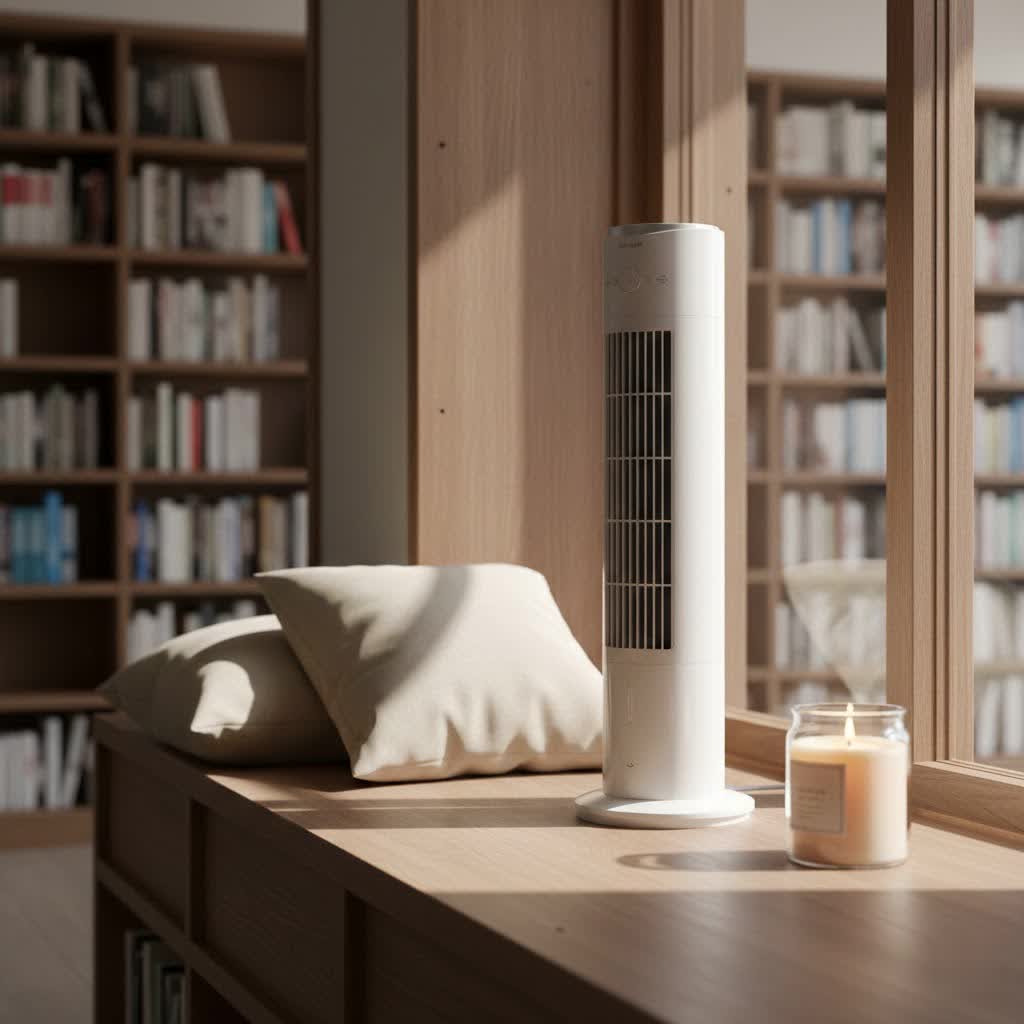
Imagine a haven of cool, circulating air, a gentle breeze sweeping through your entire living space, banishing stuffiness and enhancing comfort without the bulk or energy drain of traditional cooling systems. This is the promise of the whole room tower fan, a modern marvel in personal climate control that has transformed how we stay comfortable in our homes. Far more than just a fan, these sleek, vertical devices are engineered to deliver efficient, widespread air movement, making them an indispensable addition to any contemporary household seeking optimal airflow and refined aesthetics.
Understanding Whole Room Tower Fans: How They Work Their Magic
At its core, a whole room tower fan operates on a principle of efficient air circulation, distinct from older fan designs. Unlike traditional box or pedestal fans that push air horizontally in a concentrated beam, tower fans typically draw air from intake vents located at their back or sides. Inside their tall, slim housing, an impeller or series of blades rapidly spins, increasing the air pressure. This pressurized air is then propelled vertically through a series of vents along the fan’s height, creating a wide, consistent column of airflow. Most models incorporate oscillation, allowing the fan to rotate from side to side, further distributing this vertical airflow across a broader area of the room, effectively eliminating “hot spots” and ensuring an even, refreshing breeze. While they don’t actively cool the air like an air conditioner, by continuously circulating existing air, tower fans create a wind-chill effect that makes you feel cooler and helps disperse conditioned air more effectively throughout your space.
The Distinct Advantages and Potential Drawbacks of Tower Fans
Whole room tower fans offer a compelling blend of form and function, but like any appliance, they come with their own set of pros and cons.
-
Advantages:
- Space-Saving Design: Their slender, upright profile allows them to fit seamlessly into tight corners or discreetly alongside furniture, occupying minimal floor space.
- Quiet Operation: Many modern tower fans are engineered with advanced motors and aerodynamic blade designs to operate with remarkably low noise levels, often as quiet as 25-48 decibels, making them ideal for bedrooms or offices where tranquility is key.
- Even Air Distribution: Thanks to their vertical airflow and oscillation capabilities (often ranging from 30 to 120 degrees), tower fans excel at circulating air uniformly across an entire room, preventing stagnant air pockets.
- Enhanced Features: Most models boast convenient features like multiple speed settings (from 3 to 12+), various modes (e.g., normal, natural, sleep), programmable timers (up to 12 hours), and remote controls. Higher-end models may include smart capabilities (app and voice control) or even air purification (HEPA filters/ionizers).
- Modern Aesthetics: Their sleek, contemporary design often complements modern home decor, adding a touch of elegance rather than being an eyesore.
- Energy Efficiency: Generally, tower fans consume less energy compared to air conditioning units, offering a cost-effective way to enhance comfort.
-
Disadvantages:
- Initial Cost: Tower fans can sometimes be pricier than basic box or pedestal fans, especially models with advanced features or premium brands.
- Not True Cooling: It’s important to remember that tower fans circulate air; they do not lower the ambient temperature of a room like an air conditioner would. Their cooling effect is purely through air movement.
- Limited Power for Very Large, Stuffy Rooms: While “whole room” models are designed for broader coverage, in extremely large, uncirculated, or exceptionally hot rooms, a standalone tower fan might not be sufficient to create a truly cool environment without supplementary cooling.
- Regular Cleaning Required: To maintain optimal performance and air quality, the intake vents and internal components require periodic cleaning to prevent dust buildup.
Exploring the Diverse Landscape of Tower Fan Types
The market for whole room tower fans is rich with variety, catering to a spectrum of needs and preferences. Understanding the common types can help narrow down your choice.
- Basic Oscillating Tower Fans: These are straightforward models offering multiple speeds and an oscillation function to sweep air across the room. They are generally user-friendly and budget-friendly.
- Remote-Controlled Tower Fans: Adding a layer of convenience, these fans come with a remote, allowing you to adjust settings from across the room without needing to get up.
- Smart Tower Fans: Equipped with Wi-Fi connectivity, these advanced fans can be controlled via smartphone apps or voice assistants like Amazon Alexa and Google Assistant, often featuring auto modes that adjust fan speed based on room temperature.
- Tower Fans with Air Purification: Some models, particularly from premium brands, integrate HEPA filters or ionizers to not only circulate air but also clean it by capturing dust, allergens, and other airborne particles.
- Bladeless Tower Fans: Known for their ultra-modern design and enhanced safety (especially for homes with children or pets), these fans create a smooth, uninterrupted airflow without visible spinning blades. They are often quieter and easier to clean.
- Fan & Heater Combo Tower Fans: These versatile units offer year-round comfort, providing cooling airflow in warmer months and heating capabilities during colder periods.
Leading Brands in the Whole Room Tower Fan Arena
Several brands have distinguished themselves in the tower fan market, each bringing unique strengths to the table.
- Dyson: Renowned for their innovative bladeless technology, sleek design, and often integrated air purification, Dyson tower fans are a premium choice offering advanced features and superior air quality functions.
- Honeywell: A long-standing name in home comfort, Honeywell offers reliable and durable tower fans. Their QuietSet series is particularly praised for its quiet operation and good value, with models like the Honeywell QuietSet Whole Room Tower Fan frequently topping “best-of” lists.
- Dreo: This brand has rapidly gained popularity for its powerful yet quiet airflow, wide oscillation, and increasingly smart features. Models like the Dreo Nomad One and Dreo Smart Tower Fan Pilot Max S are frequently cited for their performance and user-friendly design.
- Lasko: Offering a range of options from budget-friendly to feature-rich, Lasko tower fans are known for their strong airflow and practical designs, with the Lasko Wind Curve often highlighted for its balance of performance and quiet operation.
- Vornado: Specializing in whole-room air circulation, Vornado tower fans (like the Vornado ARA) focus on moving air efficiently across larger spaces, often using unique contoured outlets instead of just oscillation to achieve comprehensive circulation.
- Levoit: Providing good performance at a competitive price, Levoit tower fans, such as the Levoit Classic 36″, offer strong circulation and quiet operation, making them a solid choice for those seeking value.
Comparing Popular Whole Room Tower Fans
| Feature | Dyson (e.g., Pure Cool) | Honeywell (e.g., QuietSet) | Dreo (e.g., Nomad One/Pilot Max S) | Lasko (e.g., Wind Curve) | Xiaomi (e.g., Mi Smart Fan) |
|---|---|---|---|---|---|
| Price Range | Premium (High) | Mid-Range | Mid-Range | Budget-Mid | Mid-Range (Competitive) |
| Technology | Bladeless, Air Purifying | QuietSet, Multiple Speeds | Hyperfast Airflow, Smart Modes | Wind Curve, Oscillation | Smart Home Integration |
| Design | Ultra-Sleek, Modern | Functional, Sturdy | Modern, Digital Display | Classic Tower, Slim | Minimalist, Smart |
| Noise Level | Very Low (Bladeless) | Low to Medium | Very Low (25-48 dB) | Medium | Low (Smart, DC Motor) |
| Key Features | HEPA filter, App control, Auto mode, LCD | 8 speeds, Dimmable LED, Timer | 12 speeds, 120° oscillation, App/Voice control, Auto | 3-4 speeds, 60° oscillation, Night mode, Timer | App control, Voice control, Natural breeze mode, Quiet |
How to Select the Perfect Whole Room Tower Fan for Your Space
Choosing the right tower fan involves considering your specific needs and the environment in which it will operate.
- Assess Your Room Size: For true “whole room” circulation, consider the fan’s Cubic Feet per Minute (CFM) rating and its oscillation range. Larger rooms benefit from wider oscillation (e.g., 90-120 degrees) and higher CFM to ensure air reaches every corner effectively. Some Vornado models, for instance, are specifically designed to move air through entire large rooms.
- Define Your Budget: Prices vary significantly. Determine what you’re willing to spend. Entry-level models offer basic cooling, while higher-priced fans come with premium features like air purification, smart connectivity, and quieter operation.
- Prioritize Features:
- Speed Settings & Modes: Do you need a gentle breeze or a powerful gust? Look for multiple speed options and different modes (e.g., “sleep” for ultra-quiet operation, “natural” to mimic outdoor breezes).
- Oscillation: Essential for wide air distribution. A broader oscillation angle means more comprehensive coverage.
- Timer: Useful for setting the fan to turn off after a certain period, saving energy.
- Remote Control & Smart Features: For ultimate convenience, especially if you want to control the fan from your couch or even remotely via an app.
- Air Purification: If allergies are a concern, a model with a HEPA filter or ionizer can provide added benefits.
- Consider Noise Level: Measured in decibels (dB), a lower number means a quieter fan. For bedrooms or quiet workspaces, aim for fans operating below 50 dB on their lowest settings. Many Dreo and Honeywell QuietSet models excel here.
- Check Portability: If you plan to move the fan between rooms, look for a lightweight model with an integrated carrying handle.
- Read Reviews: Consumer reviews and expert testing (like those by ReviewMatee.com) can provide invaluable insights into real-world performance, durability, and user satisfaction.
Maximizing Your Fan’s Life: Tips for Use and Maintenance
To ensure your whole room tower fan continues to perform optimally and last for years, proper usage and regular maintenance are crucial.
- Optimal Placement: Position your fan in a strategic location to maximize airflow. Placing it in a corner or near a doorway can help circulate air more effectively throughout the room. Avoid placing it directly against a wall, as this can impede air intake.
- Regular Cleaning: Dust and debris can accumulate on intake grilles and internal components, reducing efficiency and potentially impacting air quality.
- Exterior: Wipe down the exterior with a soft, damp cloth periodically.
- Vents: Use a vacuum cleaner with a brush attachment or compressed air to clean dust from the intake and output vents.
- Filters (if applicable): If your fan has an air purification function, follow the manufacturer’s instructions for cleaning or replacing filters.
- Use Correct Voltage: Always ensure the fan is connected to the appropriate power supply as specified by the manufacturer to prevent damage.
- Avoid Continuous Operation: While many tower fans are designed for extended use, giving them occasional breaks, especially during cooler parts of the day, can prolong their lifespan.
- Safe Storage: When not in use, especially during off-seasons, store your tower fan in a dry, cool place, ideally in its original packaging or covered to protect it from dust.
Tower Fans in Comparison: A Breath of Fresh Air?
When considering a cooling solution, it’s helpful to see how whole room tower fans stack up against other popular options.
- Tower Fan vs. Pedestal Fan: Pedestal fans typically have visible blades and a wider, round base, often taking up more floor space. Tower fans, with their slim, vertical design, are more space-efficient and often boast a more modern aesthetic. Tower fans generally offer more even air distribution due to their vertical vents and oscillation, whereas pedestal fans tend to focus a more direct, horizontal blast.
- Tower Fan vs. Box Fan: Box fans are highly portable and often very affordable, but they lack oscillation and tend to be louder. Their primary function is directional airflow. Tower fans offer oscillation, quieter operation, and a more stylish design, making them better suited for continuous ambient air circulation in a living space.
- Tower Fan vs. Portable Air Conditioner/Evaporative Cooler: This is the most significant distinction. Tower fans circulate air to create a cooling sensation, but they do not lower the actual room temperature. Portable air conditioners and evaporative coolers, on the other hand, actively cool the air (ACs remove heat, evaporative coolers add moisture and cool through evaporation). Portable ACs are effective but consume much more energy and require venting. Evaporative coolers work best in dry climates. If your goal is to genuinely drop the room temperature, an AC or evaporative cooler is necessary; if you want to improve air circulation and feel cooler through a refreshing breeze, a whole room tower fan is a more energy-efficient and often quieter choice.
Conclusion
Choosing the right whole room tower fan can significantly enhance the comfort and aesthetic appeal of your home. From their sleek, space-saving designs to their quiet yet powerful air circulation, these modern cooling solutions offer a compelling alternative or complement to traditional fans and air conditioning. By understanding how they work, their key features, and which brands excel, you’re well-equipped to select a model that perfectly suits your lifestyle and keeps your living space feeling fresh and invigorating. Isn’t it time you experienced the effortless comfort a well-chosen tower fan can bring to your everyday?
Frequently Asked Questions
Can a whole room tower fan truly cool an entire room?
|
Our Picks for the Best Tower Fan in 2026
As an Amazon Associate I earn from qualifying purchases.
|
||
| Num | Product | Action |
|---|---|---|
| 1 | LEVOIT Tower Fan for Bedroom, 25ft/s Velocity Standing Fan with 28dB Quiet for Sleep, Remoter, 12H Timer, 5 Speeds, 4 Modes, 90° Oscillation for Home, Office, Indoor, Bladeless 36 inch, White |

|
| 2 | Dreo Tower Fan for Bedroom, 4 Speeds, 3 Modes Standing Fans for Room with 90° wide Oscillating, 28dB Quiet for Sleep, 25ft/s Velocity, 29ft Coverage, 8H Timer, Remote, Living Room, Office, Home, White |
|
| 3 | Dreo Tower Fan for Bedroom, 90° Oscillating Standing Fans for Room with 4 Speeds, 3 Modes, 28dB Quiet for Sleep, 25ft/s Velocity, 8H Timer, Remote, Living Room, Office, Home, Black, TF117 - for Bedroom, for Room, for Sleep, 25ft/s Velocity, Living Room, Office, Home, Black |
|
| 4 | Tower Heater Fan with 4L Humidifier, 1800W Heating/Cooling, 2 Heat Levels, 3 Fan Speeds, 120° Oscillation, Indoor Space Heater with Timer & Safety Lock |
|
| 5 | Amazon Basics 28" 60-Degree Oscillating Tower Fan for Bedroom, Living Room, Office, With 3 Speeds, Intuitive Mechanical Control, Black, 35W, 27.8"H x 9.4"D x 9.4"W |
|
| 6 | Dreo Tower Fan for Bedroom, 25ft/s Velocity Quiet Floor Fan, 90° Oscillating Fans for Indoors with 4 Speeds, 4 Modes, 8H Timer, Standing Fans, Bladeless Fan, White, Nomad One (DR-HTF007) |
|
| 7 | LEVOIT Classic 36 inch Tower Fan for Bedroom, 25ft/s Airflow Standing Fan that Blows Cold Air for Home, 90° Oscillation, Quiet 28dB, Remote, 12H Timer, 5 Speeds, 4 Modes with Smart Sensor, Black |
|
| 8 | Dreo Tower Fan for Bedroom, 4 Speeds, 3 Modes Standing Fans for Room with 90° wide Oscillating, 28dB Quiet for Sleep, 25ft/s Velocity, 29ft Coverage, 8H Timer, Remote, Living Room, Office, Home, Grey |
|
| 9 | Xcity TP09Pro Bladeless Tower Fan, 3-in-1 Air Purifier, Space Heater & Cooling Fan, HEPA H13 Filtration, Remote & Touch Control, Ultra-Quiet DC Motor for Bedroom & Home Office |
|
| 10 | Dreo Tower Fan for Bedroom, 25ft/s Velocity Quiet Floor Fan, 90° Oscillating Fans for Indoors with 4 Speeds, 4 Modes, 8H Timer, Standing Fans, Bladeless Fan, Black, Nomad One (DR-HTF007) |
|
Whole room tower fans excel at circulating air throughout a space, creating a significant wind-chill effect that makes you feel cooler by promoting evaporation from your skin. While they do not lower the ambient temperature like an air conditioner, their wide oscillation and powerful airflow can effectively distribute existing cool air or fresh air, making an entire room feel much more comfortable and less stuffy.
Are tower fans noisy, especially on higher settings?
Modern whole room tower fans are designed for quiet operation. Many models feature advanced motors and aerodynamic designs that keep noise levels remarkably low, often between 25-50 decibels, even on higher settings. However, noise levels can vary between brands and models, so checking the decibel rating in specifications or reviews is advisable if quietness is a priority.
What’s the ideal placement for a tower fan to cool a whole room?
For optimal whole-room cooling, place your tower fan in a position where its oscillating airflow can cover the widest area. Corners are often effective, allowing the air to bounce off walls and circulate. Placing it near an open window or in conjunction with an air conditioner can also help distribute fresh or cooled air more effectively across the entire space.
How often should I clean my tower fan?
The frequency of cleaning depends on usage and the dustiness of your environment, but generally, a thorough cleaning every 2-4 weeks is recommended. Regularly wiping down exterior surfaces and using a vacuum or compressed air to clear dust from intake and output vents will ensure efficient operation and prevent dust buildup, which can affect air quality and performance.
